Seagrass meadows are a key ecosystem of the Great Barrier Reef and are currently in a poor to moderate condition mostly due to tropical cyclones, land-based runoff and climate change. Good water quality is critical for healthy and resilient seagrass meadows and supports recovery after acute disturbances such as extreme weather events.
Why are seagrass meadows of the Great Barrier Reef important?
Seagrass meadows are a key ecosystem of the Great Barrier Reef, and are found in coastal, reef and deepwater locations. Seagrass meadows provide multiple ecological, social, economic, and cultural (including Indigenous and non-Indigenous) values, providing critical goods and services to other species, ecosystems and local communities.

Fish nurseries

Feeding grounds

CO2 absorption

Seafloor stabilisation

Recreational fishing
The Great Barrier Reef’s coral reef ecosystems are very diverse with 450 types of hard corals and at least 1,000 species of soft corals and sea pens. They support a vast array of marine life including fish, turtles and sharks, and provide many ecosystem services and related livelihoods that are important for local communities.

450
types of hard coral

1,000
species of soft corals and sea pens
What’s the condition of seagrass meadows on the Great Barrier Reef?
Based on the results of the Marine Monitoring Program, inshore seagrass meadows across the Great Barrier Reef declined from Moderate abundance and resilience in 2017 to Poor in 2020, and while overall condition improved in 2021 (to Moderate), there were continuing declines in the Fitzroy and Burnett Mary regions. The poorer conditions in the southern regions appear to be either a legacy of recent cyclones or localised disturbances such as sediment delivery and instability of the seafloor due to physical disturbance.
How much of the Great Barrier Reef is seagrass and where are seagrass meadows located?
Seagrass meadows cover an estimated 35,679 km2 of the Great Barrier Reef World Heritage Area and occupy approximately 10% of the seafloor. Seagrass meadows are dynamic and their extent and condition change seasonally. Intertidal and shallow subtidal seagrass meadows represent 15% of the overall Great Barrier Reef’s seagrass extent (usually within 20 km of the mainland coast) and are generally denser and composed of more foundational species than deepwater meadows (> 15 m depth). Regionally, Cape York has the greatest area of seagrass overall (32%), followed by Burnett Mary (18%), Burdekin (17%), Fitzroy (17%), Wet Tropics (14%), and Mackay Whitsunday with the least (2%).
Area of coral reefs by Marine Natural Resource Management (NRM) region and shelf position
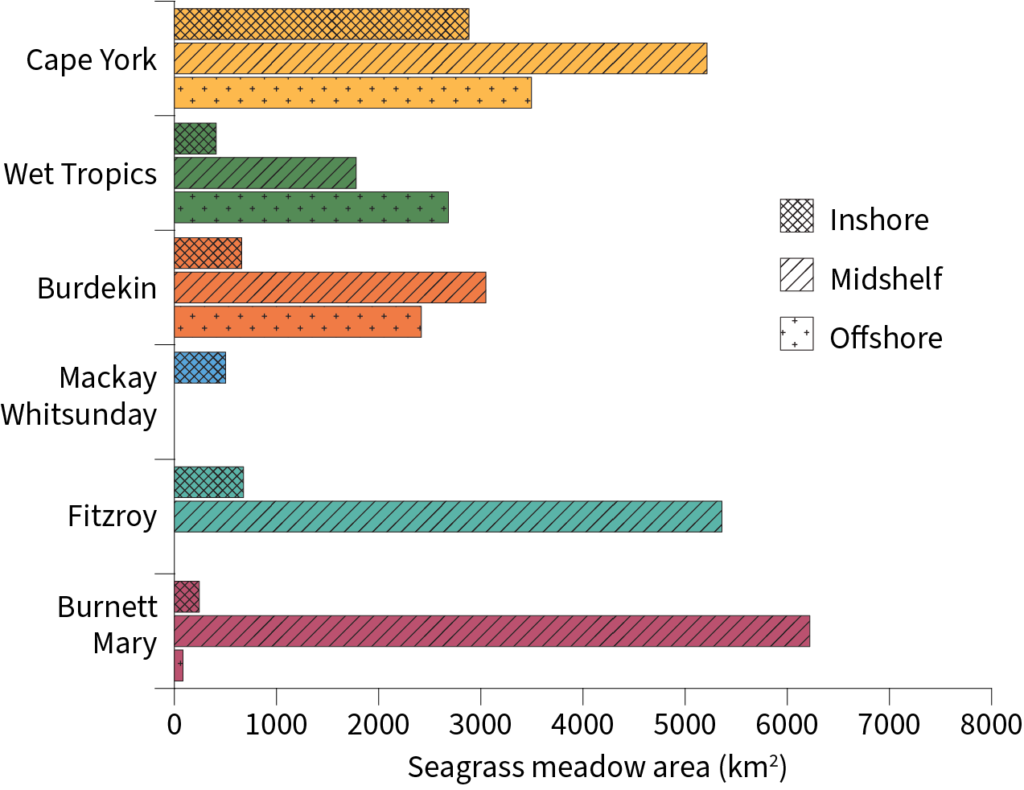
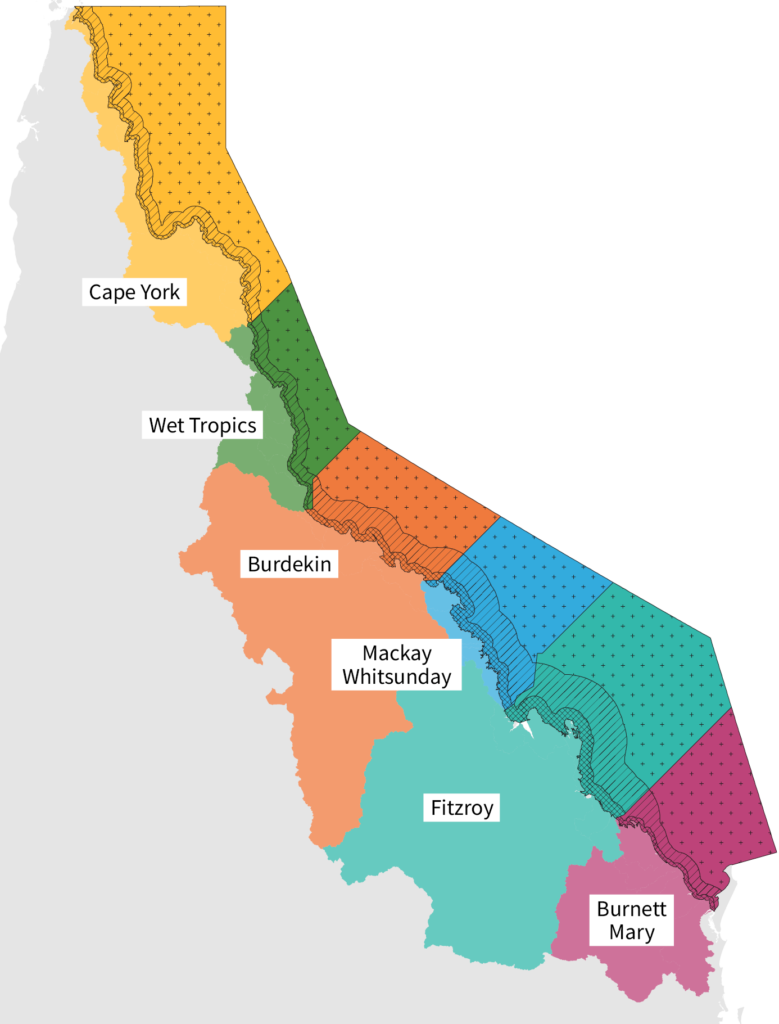
The Marine NRM regions and waterbodies are as defined by the Great Barrier Reef Marine Park Authority.
Threats

Sediments, nutrients and pesticides
run off the land into river systems when it rains and are carried to the Great Barrier Reef in flood plumes
Repeated or prolonged extreme weather and discharge events drive the greatest declines to seagrass meadows
Inshore seagrass meadows are significantly influenced by seasonal and episodic pulses of land-based runoff, particularly sediments and herbicides that are transported in flood plumes

Rising sea temperatures results in thermal stress

Cyclones and extreme weather events can cause physical damage to seagrass meadows and increase turbidity

Other threats include coastal development, dredging, fishing and boating which can cause physical damage to seagrass meadows
Water quality impacts
Sediments reduce the quantity and quality of light that can reach seagrass meadows. Increased sedimentation can affect the abundance, diversity, spatial extent and recovery rates of inshore seagrass meadows and their associated communities including fish and dugong.
Nutrients can increase seagrass growth rates, but can also contribute to greater epiphytic growth, which can partially cover seagrass leaves, leading to reduced photosynthesis
Pesticides, particularly photosystem II herbicides, are harmful to seagrass and can reduce growth and lead to seagrass mortality. These effects can be exacerbated in combination with other pressures. Modelling suggests that substantial areas of coastal seagrass are regularly exposed to herbicides in some locations.
The most important stressor for seagrass is light limitation as seagrasses need light to grow
Water quality impacts on seagrass meadows are usually highest inshore and decrease across an inshore-offshore gradient
Loss of seagrass habitat is one of the greatest threats to dugong and turtles