Human-induced climate change is the primary threat to the Great Barrier Reef and poor water quality can exacerbate climate-related impacts. Good water quality is critical for healthy and resilient coral reefs and supports recovery from disturbances such as mass bleaching and extreme weather events. Poor water quality continues to have detrimental impacts on inshore coral reefs.
Why are coral reefs of the Great Barrier Reef important?
The coral reefs of the Great Barrier Reef are globally recognised for their ecological, social, economic, and cultural (including Indigenous and non-Indigenous) heritage values.

Ecological values

Connection to Country

Recreational fishing

Commerical fishing

Tourism
The Great Barrier Reef’s coral reef ecosystems are very diverse with 450 types of hard corals and at least 1,000 species of soft corals and sea pens. They support a vast array of marine life including fish, turtles and sharks, and provide many ecosystem services and related livelihoods that are important for local communities.

450
types of hard coral

1,000
species of soft corals and sea pens
What’s the condition of coral reefs on the Great Barrier Reef?
Since the 2017 Scientific Consensus Statement, the condition of inshore coral reef ecosystems has declined, while coral cover on shallow mid- and outer shelf reefs has shown clear recovery following repeated mass bleaching, tropical cyclones and/or crown-of-thorns starfish outbreaks.
How much of the Great Barrier Reef is coral reef and where are coral reefs located?
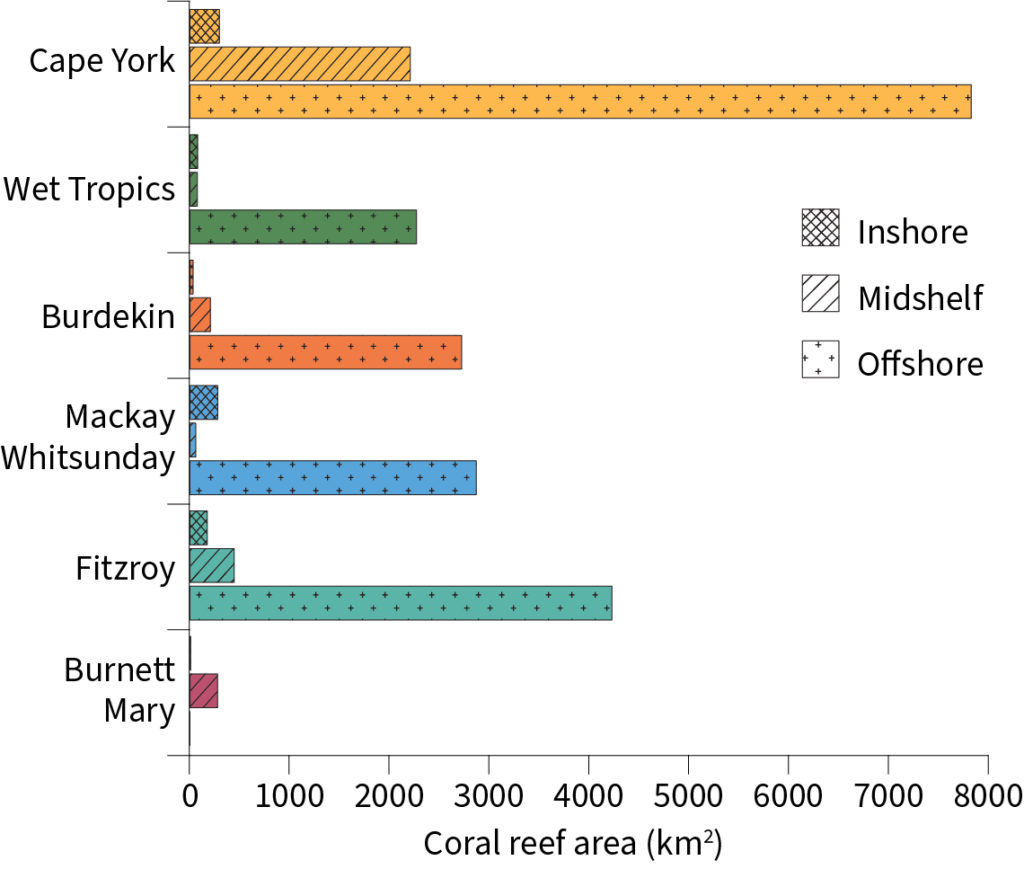
Coral reefs are estimated to cover 24,094 km2 of the Great Barrier Reef World Heritage Area with 4% located inshore, 13% in the midshelf waterbody and 83% located offshore. Regionally, Cape York has the greatest mapped area of inshore coral reefs (34%), followed by Mackay Whitsunday (32%), Fitzroy (20%), Wet Tropics (9%), Burdekin (4%), and Burnett Mary (1%).
Area of coral reefs by Marine Natural Resource Management (NRM) region and shelf position
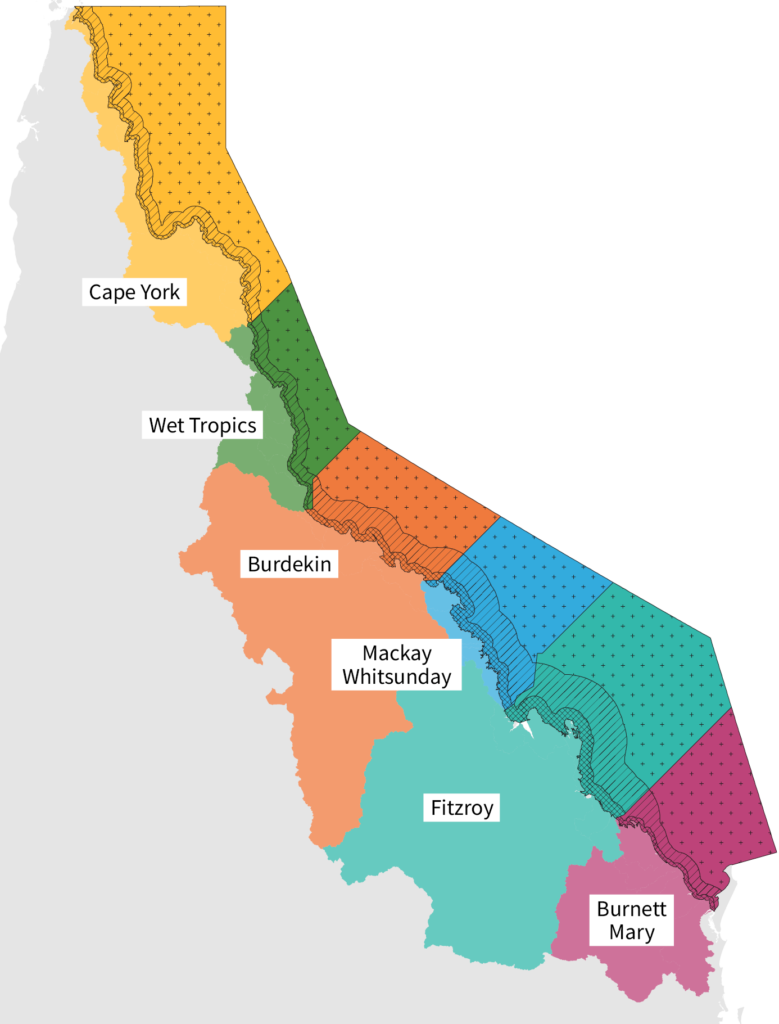
The Marine NRM regions and waterbodies are as defined by the Great Barrier Reef Marine Park Authority.
Threats

Sediments, nutrients and pesticides
run off the land into river systems when it rains and are carried to the Great Barrier Reef in flood plumes
The influence of runoff decreases with distance from river mouths
The influence of landbased pollutants varies between locations and times, and is greatest in freshwater, estuarine, coastal and inshore marine environments

Rising sea temperatures and heatwaves can lead to bleaching of corals, anemones and clams

Cyclones can cause physical damage to corals, and increase sediment resuspension and supply of marine nutrients

Crown-of-thorns starfish (COTS) outbreaks can reach plague proportions and decimate coral reefs

Ocean acidification results from oceans absorbing CO2 from the air and turning more acidic, which can reduce coral growth and increase erosion rates on reefs
Water quality impacts
Chronic poor water quality and discharge events slow reef recovery following disturbances
Increased sediment and particulate nutrient loads can smother corals and other reef-associated organisms, affect the composition of reef communities, lower coral diversity, and reduce the depth range where corals can live
Sediments can reduce water clarity and light which can cause sublethal stress and partial mortality of corals within days. Nutrients lead to increased phytoplankton biomass which can also reduce light.
Chronic poor water quality and discharge events slow reef recovery following disturbances
Some sensitive species found on coral reefs are not found in areas where sediment and nutrient concentrations are high
Pesticides are harmful to aquatic species and can increase species vulnerability to other stressors, including heatwaves and reduced light
Excess nutrients can
Sediments can affect the pelagic larval phase of corals and make it hard for new corals to find a suitable surface to settle on
be detrimental to coral health and increase coral
susceptibility to bleaching
cause phytoplankton blooms that can increase food supply for crown-of-thorns starfish larvae, possibly contributing to outbreaks