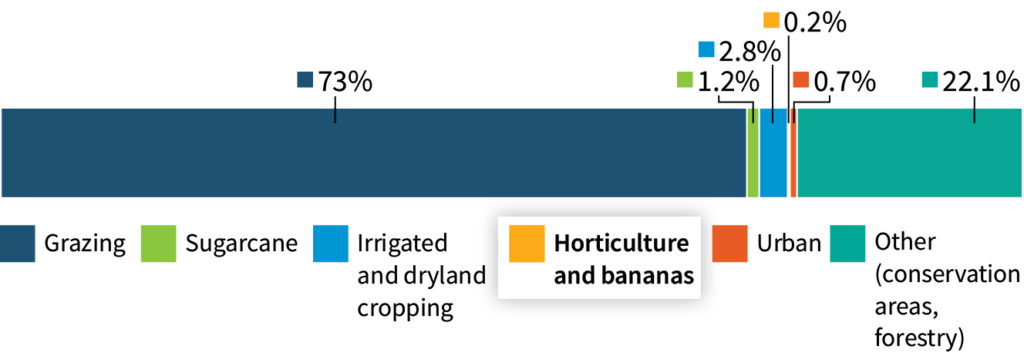
Banana growing and horticulture cover 0.2% of the Great Barrier Reef catchment, and contribute around 1% of the total fine sediment load, 1% of total exports of dissolved inorganic nitrogen, and large amounts of pesticides to the Great Barrier Reef. Much less is known about the effectiveness of management practices in bananas and horticulture to improve Great Barrier Reef water quality compared to other land uses such as grazing or sugarcane areas.
Water quality and the Great Barrier Reef
Poor water quality, which can be caused by elevated levels of fine sediments, nutrients and pesticides, has a detrimental impact on Great Barrier Reef ecosystems, particularly freshwater, estuarine, coastal and inshore marine ecosystems. These environments provide critical ecosystem services and have high tourism, aesthetic, cultural, recreational and economic values.
How do land-based activities affect water quality?
Most catchments of the Great Barrier Reef have been modified by humans. These modifications affect the type and amount of materials that runoff from land and enter our waterways.
Land uses in the Great Barrier Reef catchments
How do banana and horticulture areas contribute to overall pollutant loads?
Bananas and horticulture contribute around 1% of the total fine sediment load, and 1% of total exports of dissolved inorganic nitrogen, from 0.2% of the Great Barrier Reef catchment area. Although these land uses can generate high loads of sediments, nutrients and pesticides per unit area, their overall areas are relatively small, in comparison to other land uses. However, those exports can be locally important, and contribute to the overall pollutant loads delivered to the Great Barrier Reef.
Fine sediment and particulate nutrient loads by land use

Dissolved inorganic nitrogen loads by land use

Which areas are the dominant sources of key pollutants associated with bananas and horticulture?
Across the Great Barrier Reef, the largest contributor of fine sediment exports is grazing (60%), but in the Wet Tropics other land uses such as bananas and sugarcane produce higher loads than grazing or rainforest areas. Horticulture is also a contributor to fine sediment exports in the Burnett Mary Natural Resource Management (NRM) region.
Anthropogenic exports of dissolved inorganic nitrogen are greatest in basins dominated by fertiliser-adding land uses including those in the Wet Tropics, Burdekin and Mackay Whitsunday NRM regions, however, there is limited published information on the specific contributions of bananas and other horticulture at smaller scales across the Great Barrier Reef catchments.
Bananas and other horticulture can be large users of some pesticides, but their total area within the Great Barrier Reef catchment area is relatively small, resulting in relatively low contributions to pesticide risk. Pesticide risk from these land uses is highest in the Burnett Mary NRM region.
Across all land uses, herbicides, specifically PSII herbicides, are the most common and abundant pesticide type measured in end-of-catchment monitoring followed by other herbicide types and insecticides. Imidacloprid is the most commonly detected insecticide in Great Barrier Reef catchment area and is associated with banana, sugarcane and urban activities.
Drivers and transport pathways
Most export of land-based pollutants occur in the wet season, with chronic and continuously high exports in wet tropical catchments
Primary drivers of anthropogenic nitrogen and phosphorus export:

Fertiliser application

Changed catchment hydrology

Erosion
Primary drivers of fine sediment and particulate nutrient export:

Vegetation loss

Tillage

Reductions in ground cover and other soil disturbances
Drivers influencing pesticide export:

Timing and rate of application

Irrigation regimes

Pesticide and soil properties
Significant transport pathways
Surface runoff – dissolved nutrients and pesticides
Subsurface movement – dissolved nutrients
Groundwater – dissolved nutrients
Management options
Dissolved nutrients
There is limited evidence on the effctiveness of management practices for reducing dissolved inorganic nitrogen export in bananas and horticulture

Sediment and particulate nutrients

Reducing tillage
Controlled traffic farming

Repairing and/or revegetating eroding banks

Soil conservation structures on lands >1% slope

Retaining ground cover to reduce erosion and improve yield

Grass buffer strips can provide 30-50% trapping efficiency for fine sediment in bananas
Pesticides

Reducing the total amount of pesticide applied

Optimising application methods

Timing application to coincide with low rainfall runoff

Choosing pesticides with lower environmental risk
Reducing soil erosion

Improving irrigation efficiency
A range of non-chemical pesticide control measures hold considerable potential for reducing reliance on chemical control measures, but most are yet to be trialled in the Great Barrier Reef catchment area
Potential ecosystem impacts
Nutrients, pesticides and sediments follow a cross-shelf gradient decreasing from inshore to offshore environments
Pesticides are present in most monitored fresh, estuarine and marine waters of the GBR
Pesticides are harmful to aquatic species and can
increase species vulnerability to other stressors, including heatwaves and reduced light
Excess nutrients can
promote macroalgal growth which negatively affect corals, particularly through competition for space
be detrimental to coral health and increase coral
susceptibility to bleaching
cause phytoplankton blooms that can increase food supply for crown-of-thorns starfish larvae, possibly contributing to outbreaks
Sediments reduce the quantity and quality of light that can reach Great Barrier Reef ecosystems.
Increased sedimentation can negatively affect the abundance, diversity, spatial extent and recovery rates of inshore seagrass meadows and coral reefs and their associated communities including fish and dugong
Climate change may exacerbate the impacts of nutrients, pesticides and sediments further